





A then 26-year-old Jerad Eickhoff was on top of the world as the Phillies’ 2016 season drew to a close. Over his first 41 big league starts, spread across the previous two years, Eickhoff posted a sterling 3.44 ERA in addition to a 1.14 WHIP and 3.9 K/BB ratio. Heading into 2017, Eickhoff, alongside fellow right-handed battery mates Aaron Nola and Vince Velasquez, seemed poised to anchor the Phillies’ rotation for years to come.
But things didn’t work out that way. While Nola flourished, Eickhoff regressed heavily, battling injuries and pitching to an unsightly 4.71 ERA in 2017. He then missed the final month of the season due to numbness in his pitching hand, a malady which, combined with a strained back muscle, kept him on the IL for the majority of 2018.
But Eickhoff felt better by the end of 2018 and, after several relief outings with the big club, earned a spot start in late September against the Braves. Although he only threw 56 pitches, Eickhoff raised eyebrows, becoming the third Phillies pitcher since Steve Carlton and Curt Schilling to strike out seven consecutive batters in an outing. His final line that day included eight strikeouts in 3 1/3 innings on the back of 12 swinging (21% SwStrk) and 14 called strikes (25% C-Strk).
Eickhoff built upon that early fall 2018 performance in his first four 2019 appearances, combining elite swing-and-miss stuff with impressive contact suppression. Eickhoff’s improved statistics are backed up by pitching strategy adjustments that favor increased fastball elevation and spin rate as well as improved slider command. Eickhoff, now 28 and free of the numbness issue from corrective off-season surgery, is a pitcher on the rise and should be owned in all fantasy formats going forward.
Statistical Surge
Inclusive of that fall start against the Braves, Eickhoff has dominated hitters across his last 20.1 innings, with his strikeout rate, swinging strike rate, ERA, FIP, xFIP, and xwOBA all shaking out at elite levels in that span.
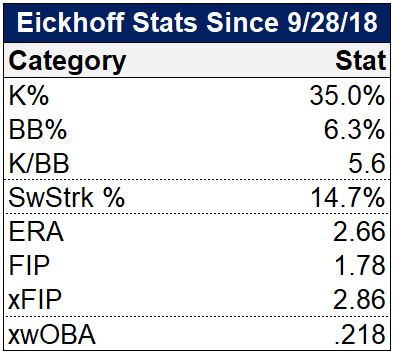
Any type of statistical analysis covering such an abbreviated sample should be conducted with skepticism. But when performance data is limited, considering the order of magnitude of production can provide insight into if a player is truly breaking out or just benefiting from short-term luck. The essential logic is that if a player is producing at an elite level which they have never achieved before in their career, it could be instructive of an underlying improvement in baseline performance.
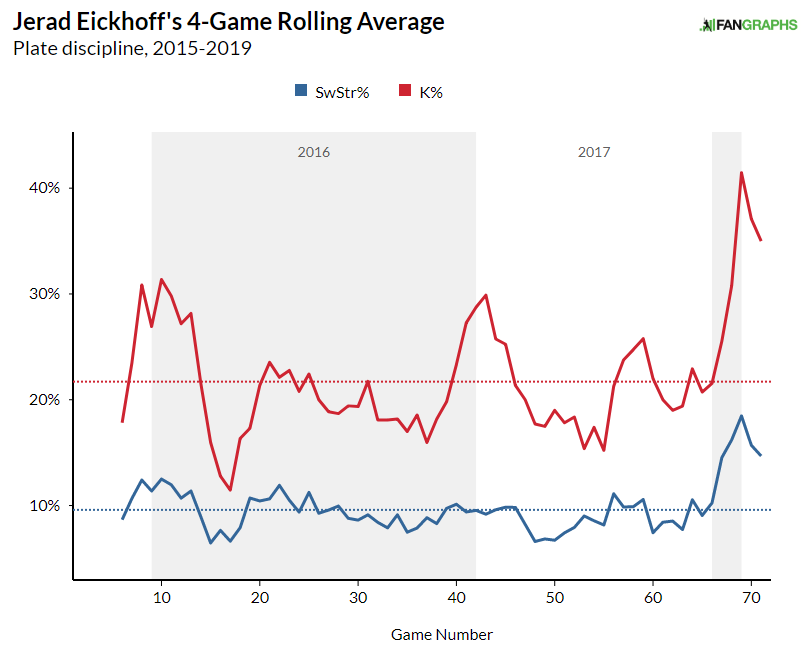
In Eickhoff’s case, there are definitely hints that he’s figuring something out. Over the four-game stretch since the Braves start, Eickhoff’s strikeout rate and swinging strike rate have reached heights he’s never experienced before.
This certainly isn’t infallible proof of improvement. There is a chance that Eickhoff is falling under the spell of The Vargas Rule, a Nick Pollack-coined term reserved for when mediocre pitchers suddenly perform like aces over several weeks, only to revert back to their previous baseline shortly thereafter. In early 2017 Jason Vargas bumped his rolling four-game strikeout rate and swinging strike rate to 31.7% and 14.5%, respectively, before regressing back into a pitch-to-contact, 4.75 ERA hurler.
But several aspects of Eickhoff’s recent run give me hope that he isn’t another Vargas. For starters, Eickhoff is still relatively young. The odds of a 28-year-old with fewer than 400 MLB innings under his belt improving is much higher than that of a 34-year old with a career 6.2 K/9. Second, the upside that Eickhoff showed over his first two seasons implies that he owns the underlying talent to improve and set a new performance baseline. And finally, Eickhoff’s domination over his last 20.1 innings stretches beyond just whiffs and strikeouts: He’s simply owned opposing hitters in all facets.
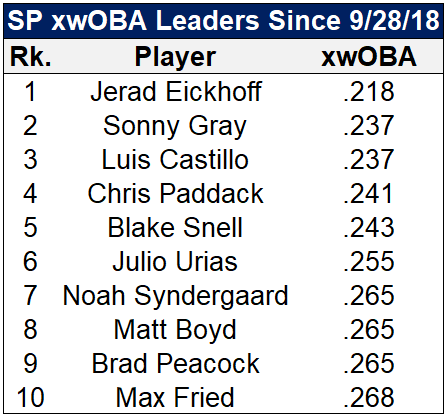
Eickhoff’s .218 xwOBA in that span, which takes into account batted ball exit velocity and launch angle along with strikeouts and walks, is easily the best in baseball among starters. Other names on this list, including Luis Castillo, Chris Paddack, Blake Snell, Noah Syndergaard, and Matt Boyd, indicate that it’s difficult for pitchers to luck their way into the top 10, even in a small sample of innings.
While no one can say for certain that Eickhoff’s statistical surge over his last four outings is indicative of real improvement, many of the signs are pointing in the right direction. Especially when considering the adjustments he’s made to his pitching arsenal in the process.
Pitching Strategy
Eickhoff is a bit of a soft-tosser, historically delivering his four-seam fastball, the most featured pitch in his repertoire, at 90-91 mph. He pairs the four-seamer with a 12-6, mid-70s curveball that ranks as one of the game’s best. Eickhoff completes his arsenal with an 85 mph slider that is beginning to serve as a great out-pitch against righties.
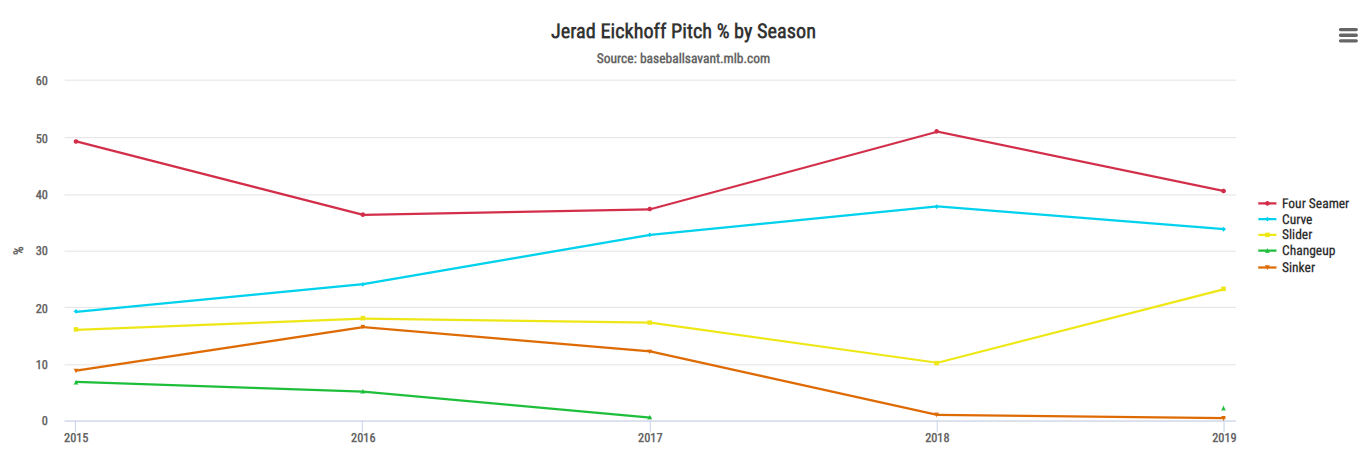
While the four-seamer, curve, and slider have been Eickhoff’s three most-used pitches throughout his career, their usage composition has shifted considerably over time. In his early days, Eickhoff used the curve and slider a combined 35-40% of the time, a figure which has vaulted to 50-55% since late 2018. With the increased breaking ball usage, Eickhoff chose to scrap his sinker, a pitch that was featured at a 10-15% rate early on.
Eickhoff’s current arsenal is reminiscent of both Rockies’ hurler German Marquez and with Cleveland starter Shane Bieber. While Marquez and Bieber throw considerably harder than Eickhoff, they each pump out their fastballs at around a 45-50% clip, supplementing them with a heavy dose of curves and sliders. This approach is rare, since pitchers normally feature either a curve or slider, but typically not both. These three righties use their slider as a primary weapon against same-handed batters while featuring the curve — rather than the more commonly seen changeup — to neutralize lefties.
One of the reasons this strategy works for Eickhoff is because his curve is such a strong pitch. Of the 61 starters that have thrown at least 750 curveballs since 2016, Eickhoff’s .173 xwOBA on the pitch is third-best, ahead of names such as Marquez, Charlie Morton, Clayton Kershaw, and Carlos Carrasco. That performance is backed up by a 37.1% swing-and-miss rate, along with an 83.6 mph average exit velocity that ranks seventh best. Here’s a beautiful clip of Eickhoff fooling NL ROY Winner Ronald Acuna Jr. with his curve in that September 28th start against the Braves.
https://gfycat.com/onlyfoolhardyairedale
But in spite of possessing an elite curve, Eickhoff’s other pitches have historically lagged behind. The fastball has ceded exit velocity averages in the 89-90 mph range with limited whiffs and ultimately pencils out as an average offering. Meanwhile, the slider, adept at earning whiffs, has given up more than its fair share of hard contact, ceding nine home runs in 2016 and five in limited innings in 2017.

Fortunately, Eickhoff has significantly reduced the launch angle on the slider since last season, a sign that he is hanging fewer in the strike zone. Moreover, the four-seamer is earning more whiffs than in previous seasons.
Up and Down
The pitch plot below outlines Eickhoff’s pitch usage and location in 2017. Notice how Eickhoff’s slider, evidenced by the yellow slices, features heavily in the middle of the strike zone. This is not where a slider should be thrown, and as a result, hitters teed off on it the tune of a .409 xwOBA that season.
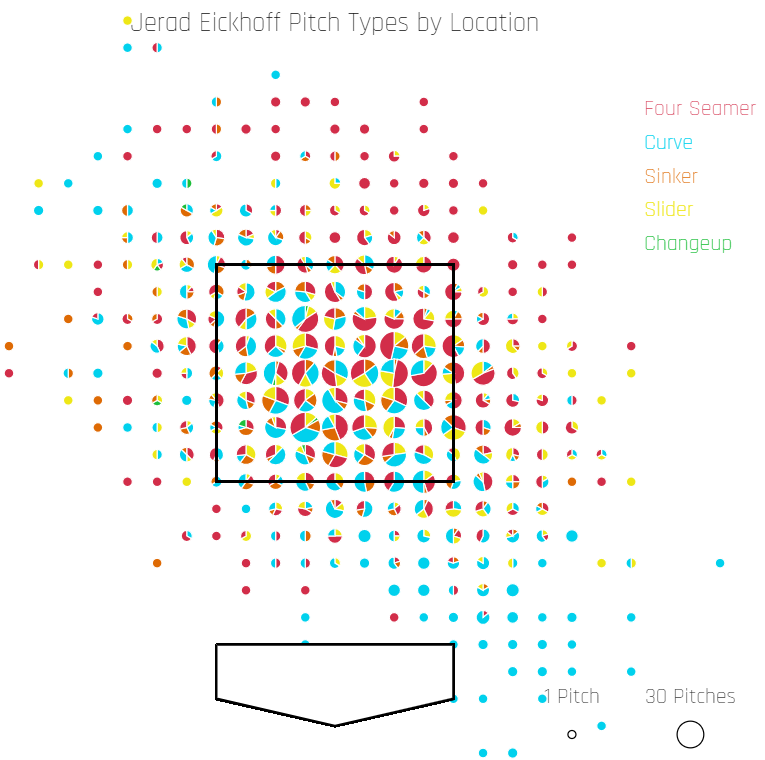
The four-seamer was also consistently thrown in the middle of the strike zone, which is fairly typical for a fastball. However, given Eickhoff’s mediocre velocity, his fastball command is likely a more integral facet of his game than a pitcher that is able to consistently throw in the mid-90s. As a result, he shouldn’t necessarily be throwing them so frequently in the heart of the plate.
Now let’s look at the plot below, detailing Eickhoff’s pitch usage and location in 2018 and 2019. The first thing that jumped out to me was that the slider is being placed lower in the strike zone than 2017, which is likely why the pitch’s launch angle decreased from 13 degrees to -3 degrees. If Eickhoff can keep this up, it will help to ameliorate the homer issues he previously faced on the pitch.
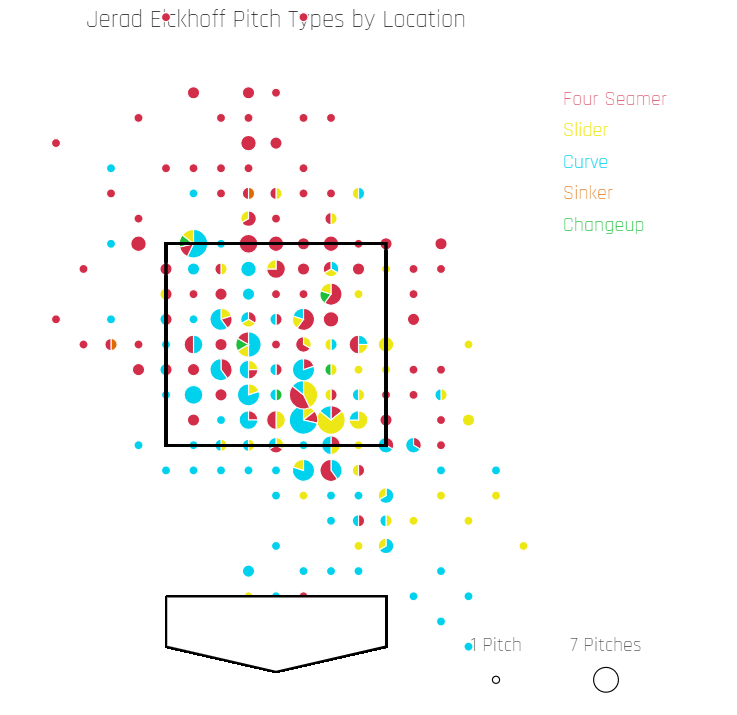
The other positive development involves Eickhoff’s four-seam fastball location. Pitcher List’s Michael Augustine has produced a variety of articles highlighting the benefits of elevating the fastball. In a nutshell, the perceived velocity of a pitch increases with elevation, especially when paired with slower breaking balls down in the zone. A pitcher like Eickhoff, whose fastball averages 90 mph, could benefit significantly from increased four-seamer elevation.
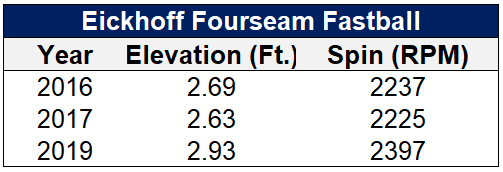
And that’s exactly what he has done. In 2017, Eickhoff’s average four-seamer elevation in the zone was 2.63 feet. In 2019 it’s up to 2.93 feet, which is among the league leaders. Impressively, Eickhoff has also significantly increased the spin rate on his fastball, a trait which increases the “rise” of the pitch and tends to result in more whiffs and pop-ups. Eickhoff’s 2019 spin rate of 2,397 rpm ranks above the 75th percentile among MLB pitchers, whereas his rates in previous seasons were below average.
The adjustments Eickhoff has made to his slider and fastball play off each other. Raising the hitter’s eye level with a high spin four-seamer and following it up with a slider low or below the zone is a textbook case of pitch tunneling and works to keep hitters off balance.
Conclusions
Eickhoff is teasing all the signs of a true breakout candidate. His statistical performance since late 2018 crests above any similarly sized sample in his career. In that time frame, he rates as arguably baseball’s most effective starting pitcher.
While we should be skeptical of small sample statistical performance, the strategic adjustments that Eickhoff has made to his repertoire give hope that the improvements are real. His slider, which was previously prone to home runs, is being featured lower in the zone and inducing more ground balls. Meanwhile, the fastball is being used higher in the zone and showing much higher spin, a quality which bodes well for increased whiffs and weak contact moving forward.
Eickhoff’s curveball was already elite. If just one of his slider or fastball were to improve he would be worth owning in every fantasy league. If both do? Watch out. Eickhoff is owned in just 14% of ESPN leagues and 21% of Yahoo leagues. Grab him now before it’s too late.
(Photo by Russell Lansford/Icon Sportswire)
