





Here’s a statline: 9 IP, 5 H, 0 R, 15 K.
Since 2000, with five hits as the maximum and 15 strikeouts as the minimum, there have been a grand total of 14 complete-game shutouts, and two of them were thrown by Max Scherzer in the same season. These are super-rare, and it takes a special pitcher to pull this off regardless of the opponent. Well, Shane Bieber was the 14th man to do it against the Orioles on May 19th.
Bieber is certainly talented. He rose through the minors while managing a collective ERA south of 3.00 in both 2016 and 2017, and after continuing this dominance for eight starts at AAA in 2018 and simultaneously showing a higher strikeout upside, the Indians had no choice but to call him up and see what he could do.
While there were certainly encouraging moments for Bieber during the 2018 season, he left us all wanting more. He demonstrated absolutely elite control throughout his minor league career, finishing seasons with walk rates under 3% (!) until 2018 when he barely climbed to 3.4% over his small sample before his call-up. He continued to show that control at the major league level by only walking 4.7% of the hitters he faced over 20 appearances.
However, for the first time in his career, hard contact (and the long ball) became a bit of an issue for Bieber. His unwillingness to walk hitters finally caught up with him, and his desire to live in the zone resulted in batters putting a fair amount of balls in play with high velocity. Bieber was in the ninth percentile of average exit velocity for qualified pitchers on Statcast in 2018 and sat above league average in barrel rate, xBA, and xSLG.
Now, Bieber is certainly a different pitcher this season, and a lot of the numbers on the surface look quite nice (30.3% K, 6.1% BB, 14.3% SwStr, 3.23 SIERA, etc); however, you don’t have to look much deeper to realize that his current output is likely unsustainable and that the changes he’s made have potentially devastating consequences.
What’s Different?
The first thing that I noticed that was very different about Bieber was how he’s deploying his repertoire in 2019. Remember, he’s always been a control-oriented pitcher who refuses to give out free passes while striking hitters out at an average to above average clip, but in 2019, Bieber has turned himself into a pure whiff-seeker.
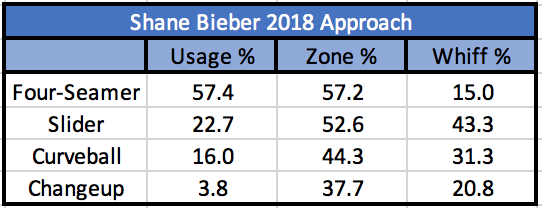
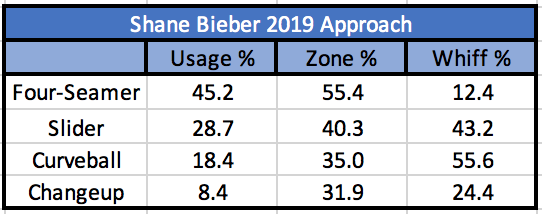
It’s immediately evident that Bieber has begun 2019 with a commitment to getting chases on breaking pitches outside of the zone. Why exactly did he decide to make such a dramatic change? Perhaps he was simply dissatisfied with the results of 2018 that I described in the introduction. There didn’t appear to be much need for Bieber to drastically adjust how he approached hitters, though.
In 2018, he ranked extremely high in CSW%, as of the 147 pitchers with at least 1500 total pitches, he was ninth on the list at 32.9%, and one of the more impressive parts of his game was his showcase slider. Bieber put it in the zone 52.6% of the time, which of the 91 pitchers who threw at least 400 sliders ranked seventh-highest. Still, despite that, it still had an amazing 26.7% swinging strike rate that was good for fifth-best of that same sample. It’s undeniably filthy.
So what was Bieber’s problem? Contact. For some reason, his stuff got hit really hard when hitters connected with it in 2018. So what was his response? Don’t let them make contact! Simple, right? Well, yes and no.
Cleveland, We Have a Problem
Bieber wants to be an ace, and is currently posting peripheral metrics that illustrate him as such, but unfortunately he’s not in a position to truly dominate teams with a level of consistency that we expect from the very best starters in the game.

This is a packed graphic, so let me give the summary. I’ve simply bucketed different counts together to represent being “even” with the hitter, “ahead” of the hitter, “behind” the hitter, or in a full count. The left-sided data compares league average xwOBAcon (expected wOBA on contact) with Bieber’s 2018 and 2019 xwOBAcon, while the right-sided data shows league average pitch distributions into each of those buckets for 2018 and 2019 and compares those distributions to Bieber’s.
For some reason, Bieber’s stuff gets blasted when hitters put the ball in play. Since becoming a major leaguer, he’s simply allowed worse-than-average contact regardless of whether he’s even with (neutral count), ahead of (two-strike count), or behind the hitter (hitter count). The good news for 2018 Bieber was that, at the very least, he was spending time in pitcher-friendly counts (neutral or two-strike) at an above average clip, so even with below average contact skills, he was still able to keep his batted ball data somewhat stable. However, 2019 Bieber is much different story.
His fifth-percentile hard hit rate of 46.7% is alarming enough, but if you look at the orange columns in the above graphic, you will notice that Bieber has seen a displacement of 4.6% of his total pitches from neutral and two-strike counts to hitter and full counts. This is extremely significant for a guy like him, as he now takes his below-average contact skills that appear to have gotten worse in 2019 and exposes them to counts in which hitters, on average, make even better contact.
Now, it’s important to understand even more specifically the repercussions of putting yourself in certain counts as a pitcher in order to further connect the dots on Bieber. If you’ve read Nick Gerli’s or my articles about two-strike rate, you would have seen this graphic by now:
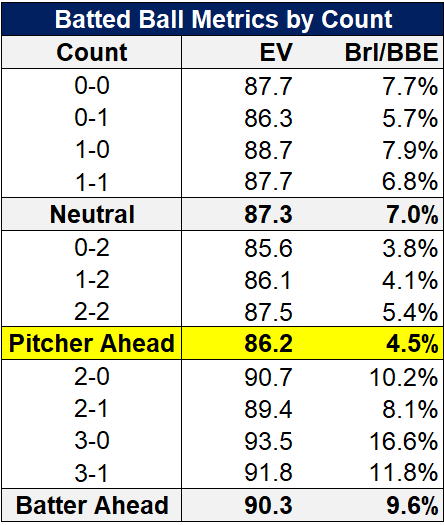
By being in fewer two-strike counts and more hitter counts, Bieber is subjecting himself to situations where he’s now vulnerable to a higher barrel rate. Does this mean that he will definitely have one? No. But he does, and there’s a reason why: He still doesn’t like walking guys. When you’re behind in counts at an average or below-average clip, you have a decision to make. You can pitch around the batter and either hope for a chase or simply move onto the next guy, or you can challenge the hitter in the zone with a pitch that can potentially be hit very hard.
You don’t have the ability to dictate the at-bat and you don’t have bullets that you can waste on hitters who are in a mindset of protecting the zone rather than driving the baseball, so you have to sacrifice either your contact or your free passes. Luis Castillo and Kyle Gibson are great examples to help illustrate this alongside Bieber.
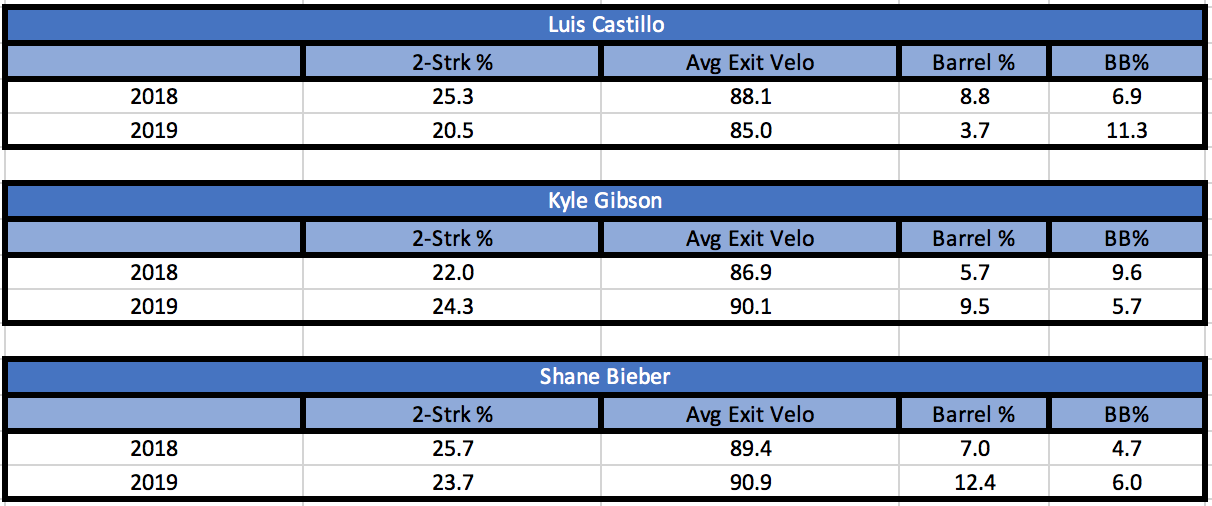
These are three pitchers who are currently average or below-average at getting to two strikes, and it’s clear in their profiles that they are making some form of sacrifice in their current state. Castillo shares a similar tale to Bieber in that he was actually a slightly above-average two-strike pitcher who decided to completely bail on throwing pitches in the zone after one season of mediocre batted ball data (league worst 39.1% zone rate in 2019). The result is a two-strike rate that sits in the bottom 9% of all starting pitchers and a walk rate that has ballooned. If Castillo wants to continue with this approach, he can, but if he wants to cut back his walk rate without changing his two-strike rate, he’s going to have to enter the zone in hitter counts, and you can be sure that his barrel rate will increase as a result.
That was exactly the case for Gibson this season. He had a very below-average two-strike rate in 2018 and decided to go the 2019 Castillo route of increasing your strikeouts and whiffs while walking those who get ahead of you and never conceding hard contact in a vulnerable count. Gibson appears to being doing the exact opposite this season, as his barrel and walk rates have almost literally swapped and his exit velocity has increased dramatically.
Bieber is now in a similar position. He’s behind hitters often, he still can’t shake the need to avoid walks that he rose through the minors with, and as a result, his already-poor contact skills have been exposed to more dangerous situations and he’s paying the price in the form of extremely hard contact and a barrel rate that is twice the league average.
The Outlook on Bieber
Honestly, it’s not great. Bieber demonstrated last year and is continuing to demonstrate this year that he has incredible upside. His ceiling is high, as he has two extremely good breaking pitches that he can throw both in and out of the zone effectively to get strikes. However, he struggles mightily when trying to keep hitters from squaring him up. Even when he puts himself in positions to succeed, he still can’t avoid being hit extremely hard when contact is made.
He’s gone from being a zone-heavy strike-seeker in 2018 to a chase-heavy whiff-seeker in 2019, and as a result, he’s seen a dip in his ability to consistently get ahead of hitters and at least preserve some semblance of weaker contact from his opponents. So why do his numbers still look great?

Bieber has gotten about as lucky as any pitcher could this season. He’s not looking down the barrel of slight regression. He’s looking at potentially being one of the biggest fallers over the remainder of 2019.
He’s already matched his home run total from last season in just over half the appearances and his 1.77 HR/9 clip (good for eighth-worst among qualified starters on Fangraphs) is very reflective of the 22 barrels he’s allowed this year. As illustrated above from a sample of all pitchers with at least 750 pitches this season, Bieber’s expected statistics (including the worst xwOBAcon in baseball) on Statcast take him from being average or even somewhat good to being one of the most unreliable pitchers in the game, and his owners need to be prepared for what is likely going to be a rough rest of the season.
Things are going to get bad for Bieber if he doesn’t adjust. Is there a happy medium between his 2018 and 2019 approach? There certainly could be, and I bet a lot of us would love to see it in action. But for now, he’s a high-upside starting pitcher with a very low floor and unavoidable negative regression on the immediate horizon.
Featured Image by Justin Paradis (@freshmeatcomm on Twitter)
